
Smart Solutions, Safer Communities
How the Lightfinder feature in Axis cameras can be a real-life saver in the dark
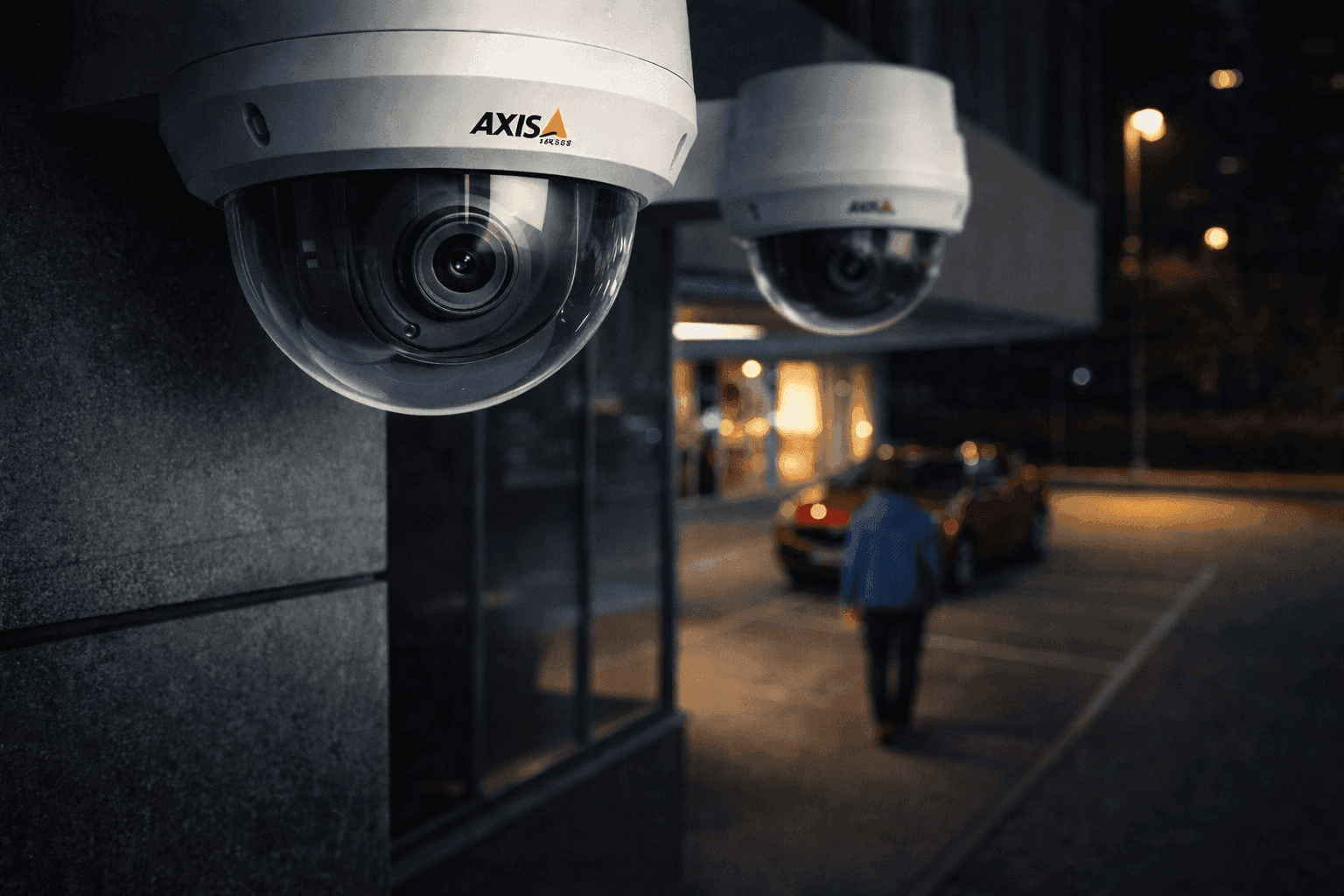
How Axis Lightfinder Protects What Matters Most in the Dark
Ever squinted at that blurry nighttime security footage on the news and thought, "What's the point?" You can see a ghostly shape moving across the screen, but you can't tell who it is, what they're wearing, or even the color of the car they drove. This isn't just a Hollywood trope; it's one of the most common low-light surveillance challenges, rendering expensive equipment useless when it matters most.
In practice, this is a critical failure. The most common night vision technology works by flooding an area with infrared light, which is invisible to our eyes but visible to a camera's sensor. The trade-off is that infrared can't see color, which is why you always get that washed-out, black-and-white image. This limitation means critical details---like the red hoodie on a suspect or the blue paint on a getaway car---are lost forever.
But what if a security camera could see in near-total darkness, almost like the human eye, only better? Imagine technology that doesn't rely on an invisible flashlight, but instead soaks up every available speck of light to paint a clear, detailed picture. Providing full color security footage in the dark isn't science fiction; it's a fundamental shift in how we achieve safety after sundown.
Summary
Axis Lightfinder delivers full-color, detailed surveillance in very low light by maximizing ambient light through a sensitive sensor, wide-aperture lens, and intelligent processing—unlike traditional IR that produces monochrome, low-detail images. This preserves crucial forensic information (the “Red Hoodie Effect”) that turns vague footage into actionable evidence. While it can’t see in absolute darkness, it excels wherever there’s even minimal ambient light and complements WDR, which solves high-contrast scenes rather than low-light ones. A final checklist helps match the right technology to your environment and evidence needs.
Why Most Night Vision Cameras Give You Ghostly Black-and-White Images
Have you ever stared at grainy night footage on the news and wondered why it's always that ghostly black-and-white? It's not because the world loses its color after sunset. It's because most cameras use a clever trick to see in the dark---a trick that comes with a massive blind spot.
This common method relies on infrared (IR) light. The best way to think of it is as an invisible flashlight strapped to the camera. It illuminates an area with a type of light that is completely invisible to our eyes, but which the camera's sensor can see perfectly. This allows the camera to pierce through the darkness and create an image where we would otherwise see nothing.
The problem, however, is that this invisible infrared light contains no color information at all. It can only reveal shapes, motion, and contrast, which is why the resulting picture is always monochrome. When you're trying to figure out how to improve security camera night vision, this is the biggest hurdle. You can't identify the color of a trespasser's jacket or a getaway car---critical details that make all the difference. This single limitation is the fundamental weakness in the security most night vision cameras provide.
Introducing Lightfinder: Seeing in Full Color When It Matters Most
So what's the alternative to that ghostly, black-and-white footage? A technology called Axis Lightfinder. Instead of giving up on color as soon as the sun sets, it's designed to find every last trace of available light---from a distant streetlamp or the moon---and use it to paint a clear, colorful picture, even when a scene looks nearly pitch-black to the naked eye.
The fundamental difference here is the goal. While traditional IR night vision simply tries to pierce the darkness, Lightfinder technology works to preserve crucial information. This is the difference between seeing a vague shape and identifying that the person is wearing a blue jacket, or that the suspicious vehicle is a dark green sedan. Those color details are precisely what can turn a meaningless clip into actionable evidence for law enforcement.
Think of it less like a camera with an invisible flashlight and more like a camera with superhuman vision. It doesn't create its own artificial light; it simply does a far better job of seeing the real light that's already there. By making its core components exceptionally sensitive, it can gather and process color and detail that other cameras completely miss.
How Lightfinder Works: A Camera with 'Super-Powered' Vision
Giving a camera superpowers isn't magic; it's about making its most important parts work together in a smarter way, much like a super-powered eye. While a standard camera gives up in the dark, Lightfinder's components are specifically designed to thrive in it.
The secret behind this low-light surveillance technology isn't one single component, but a fine-tuned combination of three enhancements that give the camera its remarkable vision. Each part has a critical job to do in turning a dark, blurry scene into a source of clear information.
This powerful trio includes:
A Super-Sensitive 'Retina' (The Sensor): The camera's sensor is like the retina in your eye---it's the part that actually captures light. Lightfinder uses a highly advanced sensor that is exceptionally good at soaking up every faint glimmer of light, long after other sensors would see only blackness. A Wide-Open 'Pupil' (The Lens): Just like your pupils get bigger to let more light in when a room is dark, Lightfinder cameras use special lenses that can open up extra wide to physically gather as much available light as possible. A Smart 'Brain' (The Processor): Capturing faint light can create a "noisy" or grainy picture. This is where the camera's brain---its powerful image processor---steps in. It intelligently cleans up the raw signal, reduces blur, and carefully brings out the natural color and sharp details. Working in perfect harmony, this combination of a sensitive sensor, a high-quality lens, and intelligent processing builds a clear, useful color image from a scene that looks nearly pitch-black.
Axis Lightfinder vs. Traditional IR: A Side-by-Side Reality Check
Most of us are used to the ghostly, black-and-white images from typical night vision cameras. This technology, known as Infrared (IR), works by bathing the scene in a light that's invisible to the human eye, essentially creating an image without color. While it's better than seeing nothing, the result is often a grainy, low-detail picture where a person is just an anonymous shape, leaving you with more questions than answers. When you need to know critical details, this old-school approach simply isn't enough.
The image below shows the dramatic difference. On the left, a standard IR camera captures a person in a dimly lit parking lot. You can tell someone is there, but that's it. Now, look at the image on the right from a camera with Axis Lightfinder technology. The scene is instantly understandable. You don't just see a shape; you see a person with brown hair wearing a blue jacket, standing near a red car. This is the power of true color night vision security---it turns a vague event into a collection of useful facts.
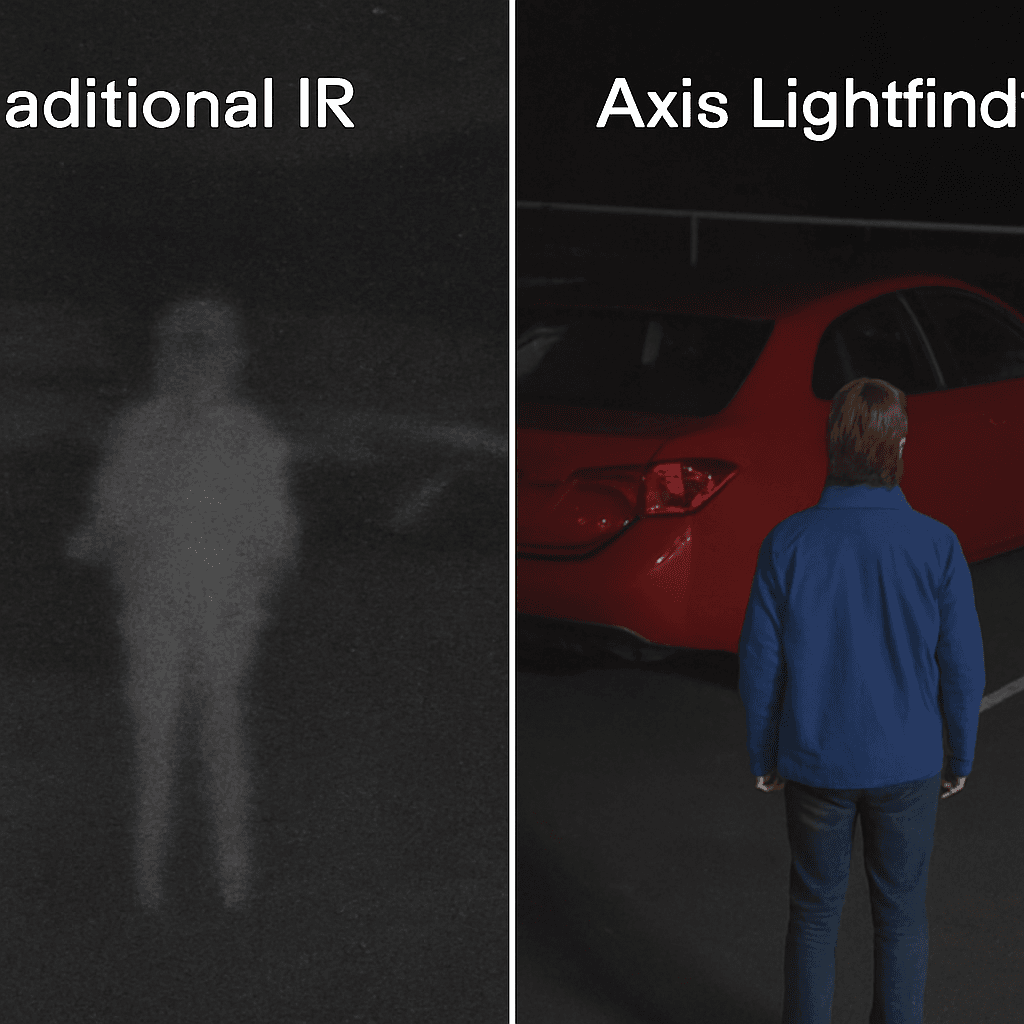
The comparison reveals the true purpose of a security camera: to provide actionable information. The ability to capture color and detail makes identifying faces from low light video possible, turning your camera from a simple deterrent into a powerful investigative tool. Which image would you rather have after an incident? Having a clear description of a suspect or their vehicle can make all the difference, a concept often referred to as "The Red Hoodie Effect."
The 'Red Hoodie' Effect: How Color Details Help Catch Criminals
The "Red Hoodie Effect" highlights a simple truth: specific details are what solve cases. Imagine police get a report of a late-night incident at a local business. With a standard black-and-white camera, the report is vague: "a person of average height." It's not much to go on. Now, picture the same scenario with a Lightfinder camera. The report becomes: "We're looking for a person wearing a bright red hoodie, blue jeans, and white sneakers." Suddenly, authorities have a concrete description they can share and act on immediately.
This level of specific, usable information is what security experts call forensic detail. It's the difference between a blurry ghost and an identifiable subject. Capturing evidence with night vision cameras is only effective if that evidence contains facts---the color of a getaway car, the logo on a jacket, or a person's hair color. Because Lightfinder technology is built to see in color, it preserves these crucial details that black-and-white footage completely erases, making it far easier when identifying faces from low light video.
This capability transforms your security camera from a passive observer into an active tool for investigation. Providing law enforcement with a detailed, colorful description is often the key to turning a frustrating event into a solved case.
Does Lightfinder Work in Complete Darkness? The Honest Answer
Can Lightfinder see in absolute, total darkness? The honest answer is no. Think of the technology as a super-powered eye, not a magic wand. Just like a cat's eye needs a tiny sliver of moonlight to see, Lightfinder needs some available light to gather and amplify into a full picture. It's an expert at making the most out of almost nothing, but it can't create a clear, detailed image from pure blackness.
Fortunately, true "total darkness" is surprisingly rare in the real world. Most outdoor spaces have what's called ambient light---the faint glow from a streetlamp down the road, the moon, or a neighbor's porch light. For a Lightfinder camera, this tiny amount of light is a feast. In typical backyards, storefronts, or parking lots, there is almost always enough ambient light for it to capture that clear, colorful image when a normal camera sees only black.
This highlights the one situation where traditional IR wins. If you need to see inside a completely sealed, windowless room with zero light, an IR camera is the right tool because it brings its own invisible flashlight. For virtually every other real-world security need, however, Lightfinder's ability to use faint ambient light to deliver crucial color details provides far more useful evidence.
Lightfinder vs. WDR: Choosing the Right Tool for the Right Problem
That challenge of mixed lighting---bright sun and deep shadows in the same frame---is a classic problem for security cameras. Think of a sunny day seen through a store's glass door; a standard camera will either show the person inside as a dark silhouette or turn the entire sunlit street outside into a blinding white glare. Your own eyes can adjust instantly, but cameras need help. This is precisely the problem that a technology called Wide Dynamic Range (WDR) was designed to solve.
Instead of gathering faint light like Lightfinder does, WDR works by essentially taking two pictures at the exact same time: one exposed for the bright areas and another for the dark areas. It then intelligently merges them into a single, clear image where nothing is hidden. With WDR, you can see the details on a person's face inside a shaded entryway and simultaneously read the license plate of a car in the bright parking lot behind them.
This makes the difference between Lightfinder and WDR simple: they are different tools for different jobs. Lightfinder is your solution for overall low light , turning a dimly lit scene into a clear, colorful image. WDR, on the other hand, is your solution for high-contrast light, balancing out scenes that have both bright spots and dark shadows. They aren't competitors; in fact, many of the best CCTV systems for low-light conditions include both, giving you the power to see clearly no matter the lighting challenge.
Is Your Security Ready for the Dark? A Final Checklist
Settling for grainy, black-and-white footage that leaves you guessing is no longer necessary. The benefits of color night vision security---the difference between seeing a vague threat and identifying the color of a getaway car---fundamentally change the approach to choosing a camera for 24/7 surveillance. You can move from being a passive observer to an active protector of your space.
To decide what's right for your property, use this simple checklist to improve your security camera night vision plan:
Details Needed: Do I just need to see movement, or do I need to identify faces, clothing, and license plates? Light Available: Is there any ambient light from streetlights or windows, or is it absolute, pitch-black darkness? Cost of Missing Out: What is the real-world cost if I can't provide police with a critical detail? Answering these questions moves you beyond confusing technical specs and focuses on what truly matters: getting clear, actionable answers when an incident occurs. You're no longer just buying a camera; you're investing in clarity and confidence, ensuring the darkness doesn't get the final say.
Related services: Outdoor surveillance systems · CCTV installation in Abu Dhabi
Related reading: Why HDD Prices Have Skyrocketed by 46% in 2026
About the Author

Share this article

Connect With Us
Our Office Locations
Abu Dhabi
Head Office
Dubai
Branch Office
India
Branch Office - Calicut