
Smart Solutions, Safer Communities
The Invisible Layer of ELV Projects: What Happens Between Drawing Approval and Final Handover

Where Planning Ends and System Integration Begins
That approved blueprint for your new office? It’s just the starting pistol. Long before a single cable is pulled, a critical 'paperwork' phase determines if the project succeeds or fails. This is what happens right after shop drawing approval, and it’s where the high-tech promise of the design meets the real-world challenge of getting the right equipment onto the construction site. This invisible step ensures the technology you end up with is the technology you were promised.
Think of this first stage like showing an interior designer the exact model of TV and speakers you want before anything is purchased. This is the material submittal process. The ELV team formally submits the technical specifications for every camera, access reader, and Wi-Fi point to the project consultant. It’s a crucial quality check that ensures the high-resolution camera from the design is exactly what gets ordered, preventing cheap substitutes from being used.
Only after the consultant gives this formal ‘green light’ does procurement begin. This isn't just online shopping; it's the official, complex process of ordering, tracking, and managing the delivery of thousands of components. Properly managing ELV project procurement ensures all the approved gear arrives on schedule, ready for installation. This meticulous planning is the invisible foundation that guarantees the building's 'nervous system' is built with the right parts.
Creating the Real-World Installation Map: Shop Drawings vs. Blueprints
An architect’s blueprint is a great starting point, showing what needs to be installed, like a security camera in a lobby. But it often lacks the nitty-gritty details of how and precisely where. This is where shop drawings come in. Think of them as the hyper-detailed instruction manual created by the ELV team. They mark the exact height of a device down to the inch, the specific path cables will take through the ceiling, and how a device will be mounted, turning the design concept into a practical, step-by-step installation guide.
The real magic of these drawings, however, is in what we call trade coordination. A construction site is a crowded place, with electricians, plumbers, and HVAC teams all competing for limited space within walls and ceilings. A shop drawing prevents on-site clashes by overlaying the ELV plan with everyone else's. This process resolves conflicts on paper before they happen in reality—for instance, ensuring a Wi-Fi access point isn't planned for the same spot where a giant air duct needs to go.
By adapting the original design to the messy, real-world conditions of the site, these approved shop drawings become the definitive map for the installation team. They are the final check that transforms planning into a coordinated, actionable strategy. With this detailed guide in hand, technicians can finally begin the monumental task of pulling thousands of feet of cable through the building’s skeleton.
The Organized Chaos of Installation: How Thousands of Feet of Cable Find Their Home
With the final plans approved, the quiet phase of paperwork gives way to physical work. Following the shop drawings like a treasure map, installation teams begin running thousands of feet of cable through the building’s skeleton. This process, known as "cable pulling," is like threading a needle on a massive scale. Bundles of wires for internet, security, and AV systems are pulled through conduits in the ceiling, down walls, and under floors, creating the foundational pathways for all the building's technology.
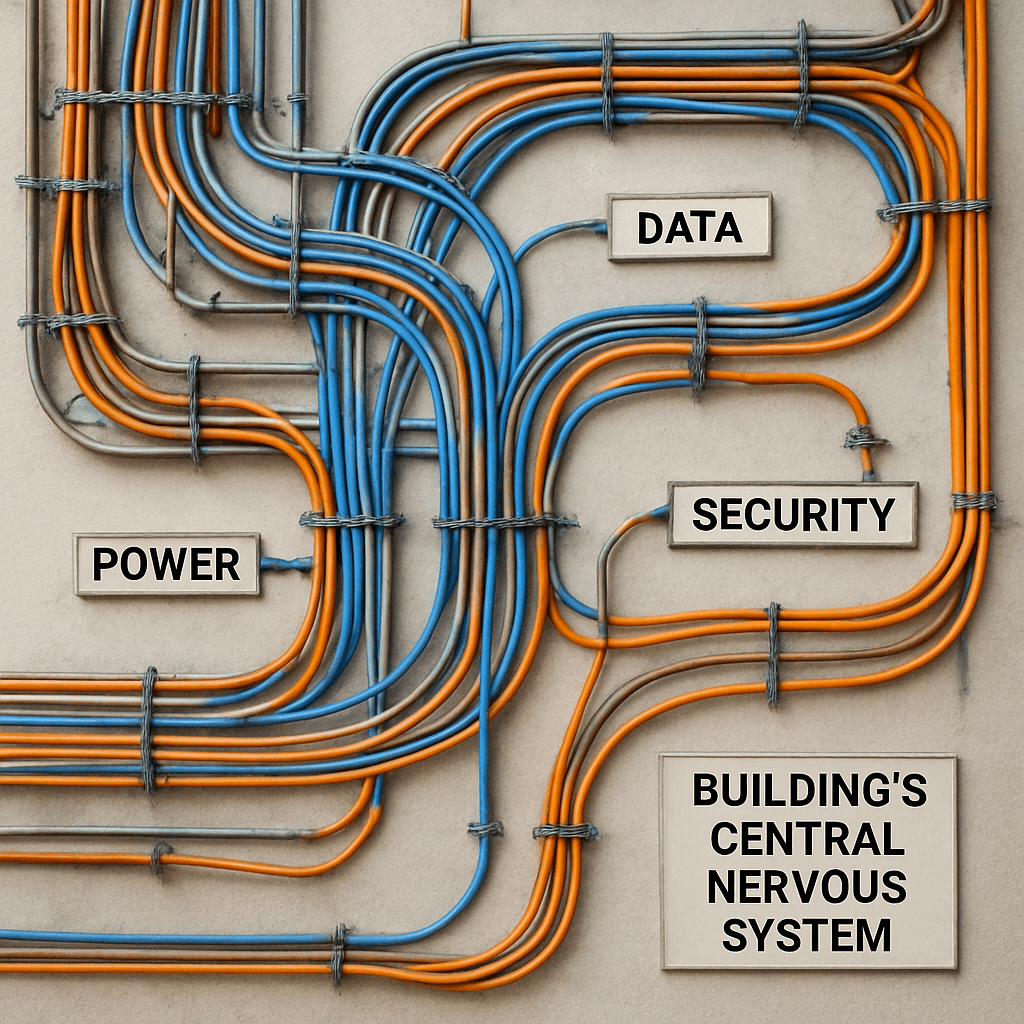
This isn’t just a few wires, but a complex web. A single floor in a modern office might require miles of cabling for hundreds of different devices. As you can see in the image, these aren't just thrown in randomly. They are carefully organized into trays and supports, often color-coded, to keep different systems separate and prevent interference—ensuring the fire alarm cables don’t get tangled with the Wi-Fi network.
But how does a technician tell one identical-looking blue cable from another? This is where the most critical, low-tech tool comes in: the label. Every single cable is given a unique identifier on both ends, corresponding to the shop drawing. This simple tag ensures the cable pulled through the ceiling on the 5th floor correctly connects to the security camera in meeting room 5B, not the one down the hall.
This network of carefully placed and labelled wires forms the building’s central nervous system. For now, it’s just a collection of potential pathways and loose ends. The next crucial step is to breathe life into them by making the right connections.
From Loose Wires to Live Connections: The Meticulous Art of Termination
After the massive effort of cable pulling, the building is filled with thousands of labeled, but lifeless, wires. This is where the meticulous art of "termination" begins. Termination is the skilled process of taking the raw end of a cable and precisely attaching a connector or wiring it into a device. Think of it like the difference between a loose speaker wire and one that’s been properly connected to the terminals on your home stereo—one is just a wire, the other is ready to make music.
This isn’t as simple as plugging in a lamp. For a single network port, a technician must arrange eight tiny, color-coded wires in the exact right order before crimping on a connector. For a security door reader, they must connect multiple wires to the correct terminals to control the lock, the reader, and the power. One wrong move, and the device won't work. This step turns a bundle of potential into a series of functional, individual connections.
But is the connection a good one? Before the entire system is ever switched on, each of these connections must be individually tested. Using specialized handheld testers, technicians will plug into a newly terminated network port to confirm it can carry data at the required speed. They’ll swipe a test card at a door reader to ensure it beeps. This phase is a deliberate, one-by-one quality check to verify that the physical link between the cable and the device is perfect.
This painstaking process is what separates a reliable system from a future maintenance headache. Finding and fixing one faulty connection among hundreds is far easier now than after the walls are closed and the entire network is live. With every individual device terminated and tested, the project has a complete set of solid building blocks. The next challenge is teaching them all to work together.
The "Aha!" Moment: How Individual Gadgets Become a Smart System
At this point, the building is filled with hundreds of perfectly connected and individually tested devices. A network port is confirmed live, a security camera has power, and a door reader beeps when presented with a card. But a collection of isolated gadgets doesn't create a smart building. How do you get all these separate parts to work together as a single, intelligent unit?
This is where the crucial phase of commissioning begins. Think of it like a symphony conductor stepping up to the podium. While the previous testing phase ensured each musician could play their notes correctly, commissioning is the act of getting the entire orchestra to play a complex song together, in perfect harmony. It’s the formal process of testing and proving that all the separate ELV systems can communicate and function as one.
A key part of commissioning is verifying the system integration—the “if-then” logic that makes a building truly responsive. For instance, technicians will intentionally trigger a fire alarm (System A) to ensure it automatically sends a command to the access control system (System B) to unlock all emergency exit doors. This critical link, a cornerstone of ELV project management best practices, is what turns a building from a simple structure into a safe, responsive environment.
Finally, the team performs a full demonstration for the project owner, walking through a series of site acceptance test procedures to prove every integrated function works as designed. This is the ultimate quality check, the final performance that prevents those frustrating day-one glitches. It confirms the building’s electronic nervous system is ready for the real world. But even after this grand test, there’s one last step to ensure absolute perfection.
The Final Polish: What a "Punch List" Is and How It Guarantees Quality
With the system running like a well-oiled machine, the project is tantalizingly close to the finish line. But before the final sign-off, there’s a crucial quality control step that’s all about chasing down tiny imperfections. Think of it like the final walk-through of a new home, where you might spot a small scuff mark on a wall or a cabinet door that doesn’t quite close flush. It’s not a major failure, but it isn’t perfect.
This process, sometimes called snagging in construction projects, results in a document called the punch list. The project owner and their consultant walk the entire site and create a formal list of every minor issue needing correction. Creating an ELV project punch list is a collaborative effort to spot things that, while not system-critical, fall short of the final quality standard. The list might include items like:
- -Lobby Camera (C-01): Angle is too low, adjust to cover main entrance fully.
- -Office 204 Door: Key card reader is slow to respond (takes >3 seconds).
- -Meeting Room 3: Wi-Fi signal is weak in the far corner.
The contractor is then obligated to work through this list—or "punch it out"—and fix every item until the client is completely satisfied. Only once every snag has been resolved can the project be officially closed. This final approval clears the way for the last, and perhaps most important, piece of the puzzle: the final project handover documentation.
Handing Over the Keys: Why Manuals and Final Drawings Are Non-Negotiable
With every item on the punch list checked off, the project is officially complete, but the job isn't finished. The original blueprints are the plan, but during construction, slight changes are inevitable—a cable has to be run a different way, or a sensor is moved a few feet. The team must now create as-built drawings, which are the final, perfectly accurate maps of where every wire and device is located. This final project handover documentation is the treasure map a future technician will need to fix a problem years down the road, preventing a small issue from becoming a major, wall-opening investigation.
Just as important as the final drawings is ensuring the client knows how to operate their new systems. This is where client system training comes in. It’s a critical step where the installation team teaches the building’s staff how to perform key tasks, like adding a new employee’s key card, reviewing security footage, or rebooting the network. Without this transfer of knowledge, the powerful technology is just an expensive, confusing appliance. Effective training empowers the building's own team to manage their environment effectively from day one.
Ultimately, a professional handover is far more than a handshake. It’s the delivery of a complete package containing the as-built drawings, system manuals, warranty information, and training records. These ELV project management best practices ensure the client isn’t just buying equipment, but a fully functional, documented, and manageable solution. This invisible work guarantees that the building’s electronic nervous system is ready not just for today, but for the years to come.
Beyond the Blueprint: Appreciating the Invisible Work in Every Smart Building
Where you once saw simple convenience, you now see a hidden journey. You understand the intricate ELV project execution phase that transforms a paper blueprint into the living, breathing nervous system of a modern building. That gap between a plan and a working system is no longer a mystery.
Your new knowledge gives you a special lens. The next time you're in an office or hotel, notice the technology around you. When it all works seamlessly, you can appreciate it as a quiet victory over common ELV project challenges, a sign of expert project management best practices in action.
From now on, swiping a key card or joining a Wi-Fi network isn't just an action—it's an appreciation. You are no longer seeing magic. You are seeing the successful, tangible result of that invisible layer of expertise and effort that brings our digital world to life.
Related services: Structured cabling systems · CCTV systems · Access control systems · Audio visual solutions
Related project: AV, SOC and ELV solutions at Mubadala Tower, Abu Dhabi
Related reading: Structured Cabling Mistakes That Quietly Kill Network Speed (But Nobody Checks)
About the Author

Share this article
Connect With Us
Our Office Locations
Abu Dhabi
Head Office
Dubai
Branch Office
India
Branch Office - Calicut