
Smart Solutions, Safer Communities
Steel Bollards: Types, Crash Ratings and Spacing Guide
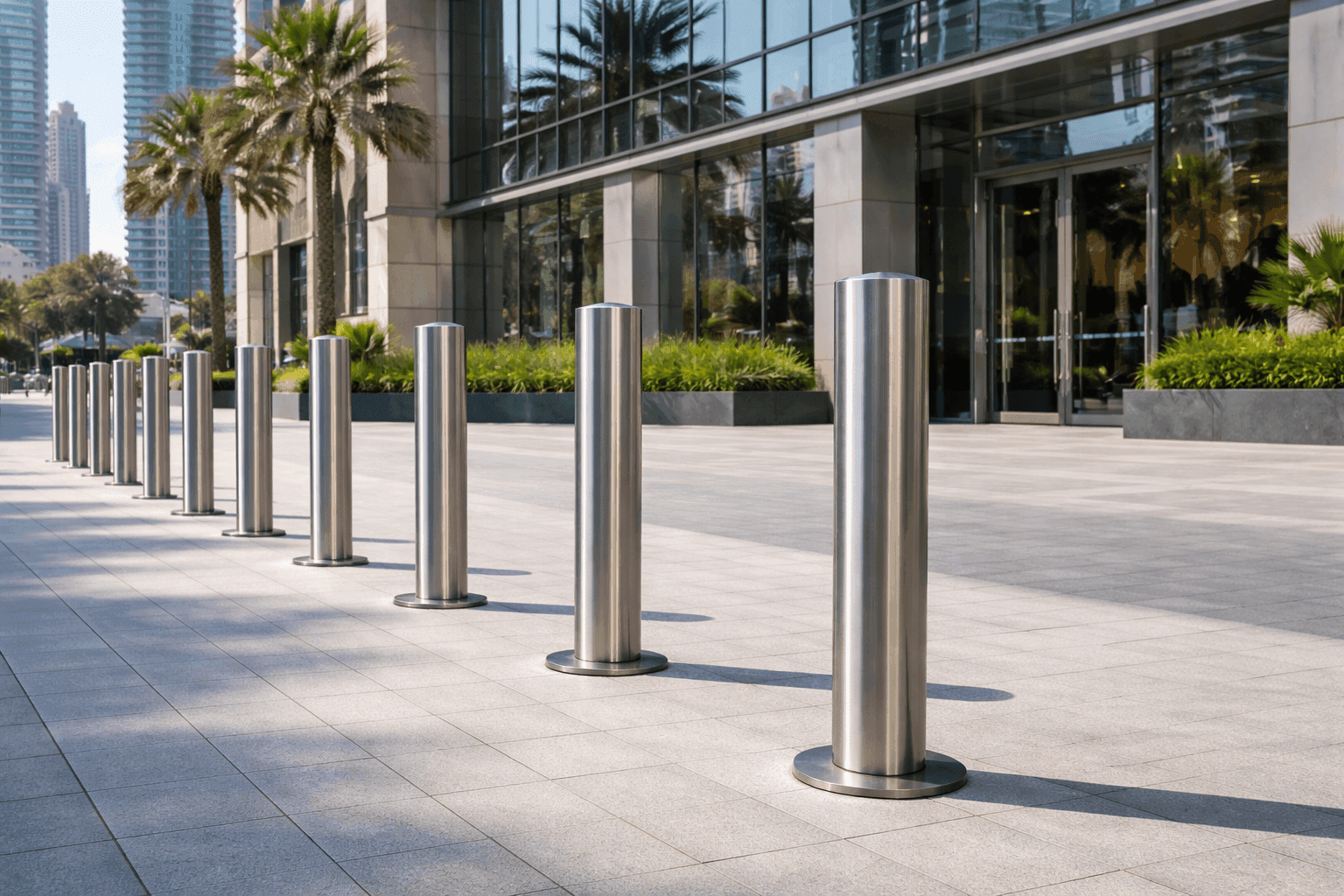
Steel Bollards: Types, Crash Ratings, Spacing and Finishes
Steel bollards are short, strong posts that keep vehicles away from people, buildings and equipment. In the UAE you see them outside malls, hotel entrances, schools, petrol stations, warehouses, government buildings and car park ramps. They all look similar, but they are not all built for the same job. Some only guide traffic. Others are engineered and tested to stop a truck.
This guide explains the main types of steel bollards, what a crash rating means, how far apart bollards should be, how they are installed, and which finish (stainless steel or galvanised steel) suits the UAE climate. It ends with a short FAQ.
Guidance Bollards vs. Security Bollards
The first question is what the bollard has to do.
- Guidance (non-rated) bollards mark walkways, protect landscaping and stop cars parking on pavements. They are usually light steel tubes on a small footing or bolted to the slab. They make a clear boundary, but they are not designed to stop a vehicle that is driven into them.
- Protection (impact) bollards are heavier steel posts, often filled with concrete, set in a deeper footing. They protect shopfronts, columns, fuel pumps, loading docks and machinery from accidental impacts.
- Security (crash-rated) bollards are tested to stop a specific vehicle at a specific speed. They are used for hostile vehicle mitigation (HVM) at sensitive buildings, embassies, data centres, stadiums and other high-risk sites.
If the risk is a deliberate attack rather than a parking mistake, only a tested, crash-rated product is the right choice.
What a Crash Rating Means
A crash-rated bollard has been tested in a real vehicle impact under an international standard. The most common standards are:
- ASTM F2656 (USA): ratings such as M30, M40 and M50, where the number is the test speed in mph for a medium-duty truck, plus a penetration rating (P1 is the best, meaning very little penetration past the bollard line).
- PAS 68 (UK) and IWA 14-1 (international): ratings that state the test vehicle, its weight, the impact speed and how far the vehicle travelled past the barrier.
A rating only applies to the product as it was tested, including the foundation design. When comparing products, check the test vehicle, the speed, the penetration distance and the foundation the rating depends on.
Why a Bollard's Strength Is Mostly Underground
A steel post on its own is not what stops a vehicle. The strength comes from the foundation. For security bollards, installers excavate a trench or pit, set the steel posts or a linked base frame, and pour a reinforced concrete footing around them. When a vehicle hits the bollard, it has to move that buried mass of concrete as well as the steel.
Foundation depth depends on the product and the rating. Traditional crash-rated bollards often need a footing around 1 m to 1.5 m deep, while shallow-mount systems are designed for sites with services, basements or podium slabs just below the surface. Before any digging, the site should be scanned for cables, pipes and drainage, and the design should match the manufacturer's tested foundation detail.
Fixed, Removable or Automatic Bollards?
The second question is whether vehicles ever need to pass.
- Fixed bollards are permanently set in concrete. They are the simplest and most robust option for frontages, pedestrian zones and equipment protection where vehicles never need access.
- Removable bollards lock into a ground sleeve and can be lifted out with a key. They suit fire lanes, maintenance access and event spaces that only open occasionally.
- Automatic (retractable) bollards rise and lower hydraulically or electromechanically. They are used at controlled vehicle entrances, often together with gate barriers, ANPR cameras, access control readers and intercoms, so authorised vehicles can pass without a guard lifting anything.
- Semi-automatic bollards lower under the driver's or operator's control and rise again with a gas spring, a lower-cost option for less frequent access.
Many sites use a mix: fixed bollards along the frontage, with an automatic or removable section at the vehicle entrance.
Stainless Steel vs. Galvanised Steel Bollards in the UAE
The UAE climate is hard on outdoor steel: strong sun, high summer temperatures, humidity and salt air near the coast. The finish decides how long a bollard keeps its appearance.
- Stainless steel (SS) bollards have a clean, modern look and resist rust through the metal. For coastal and waterfront sites, grade 316 stainless steel is usually preferred over 304 because it handles chlorides better. Stainless steel costs more but needs little more than cleaning.
- Galvanised steel bollards are protected by a hot-dip zinc coating and are very durable and budget-friendly. They are often powder-coated (for example yellow, black or a brand colour) and fitted with reflective bands for night visibility. In strong sun, coloured powder coat can fade over time, so plan for occasional touch-ups.
- Stainless steel sleeves over a steel core combine the look of stainless steel with the strength of a heavy steel or concrete-filled core, and are common on security bollards.
How Far Apart Should Bollards Be?
Spacing is a balance between stopping vehicles and letting people through.
- For vehicle protection, a clear gap of no more than about 1.2 m (1,200 mm) between bollards is common guidance, so a car cannot pass between them.
- For pedestrians, wheelchairs and prams, the gap should stay wide enough for comfortable access, typically at least about 0.9 m to 1.0 m clear. Always check the accessibility rules and the authority requirements that apply to your project.
- Measure the clear gap between the faces of the bollards, not the distance between centres, because bollard diameters vary.
For height, around 0.9 m to 1.0 m above finished ground level is typical, so bollards are easy to see from a driver's seat without blocking views of the shopfront. Crash-rated models follow the height they were tested at.
Bollards and Approvals in the UAE
Security bollards are often part of a wider site security design that the authorities review. In Dubai, for example, sites that come under SIRA requirements may need approved products and an approved installer for vehicle barriers and bollards. See our SIRA approved bollards page for the bollard options we supply and install, and talk to us early so the bollard line, foundations and access control are designed together.
Planning a Steel Bollard Project
A typical bollard project with Transit covers:
- Site survey and risk review: vehicle approach routes, speeds, what needs protecting and where vehicles must still pass.
- Product selection: guidance, protection or crash-rated; fixed, removable or automatic; finish and colour.
- Layout and foundation design: spacing, height, utility scan and the tested foundation detail.
- Installation: excavation, setting, concreting and, for automatic bollards, power, drainage, controls and safety loops.
- Integration and handover: connection to access control, barriers and CCTV where needed, testing, training and a maintenance plan.
For wider perimeter security, see our physical security solutions and traffic control and parking management pages. If your building has large glass frontages, read why security bollards matter for glass buildings.
Steel Bollards FAQ
What is a steel bollard?
A steel bollard is a short, strong post made from steel tube or solid steel, set into the ground to control or block vehicle access. Guidance bollards mark boundaries; protection and crash-rated bollards are built to absorb or stop vehicle impacts.
What is the difference between a crash-rated bollard and a normal bollard?
A crash-rated bollard has passed a real vehicle impact test under a standard such as ASTM F2656, PAS 68 or IWA 14-1, so its stopping performance is known for a stated vehicle and speed. A normal bollard has no tested rating.
How far apart should steel bollards be?
A clear gap of no more than about 1.2 m is common guidance for stopping cars, while keeping at least about 0.9 m to 1.0 m clear for pedestrian and wheelchair access. Measure the clear gap between bollard faces and check the rules for your project.
How deep do bollard foundations go?
It depends on the product. Crash-rated bollards often need footings around 1 m to 1.5 m deep, and shallow-mount systems are available where services or slabs prevent deep excavation. Always follow the manufacturer's tested foundation design.
Are stainless steel or galvanised steel bollards better in the UAE?
Both work. Grade 316 stainless steel is the low-maintenance choice for coastal sites and premium frontages. Galvanised and powder-coated steel is more economical and very durable, but coloured coatings may need touch-ups after years of strong sun.
Can automatic bollards work with access control?
Yes. Automatic bollards can be controlled by access control readers, ANPR cameras, remote controls or a guard station, and can work alongside gate barriers and CCTV at the same entrance.
Does Transit supply and install bollards in Dubai and Abu Dhabi?
Yes. Transit designs, supplies, installs and maintains bollards and vehicle access systems across the UAE. Contact us for a site survey or a quote.
About the Author

Share this article

Connect With Us
Our Office Locations
Abu Dhabi
Head Office
Dubai
Branch Office
India
Branch Office - Calicut