
Smart Solutions, Safer Communities
Importance of Security Bollards in Glass buildings

Why Glass Buildings Need Vehicle Impact Protection
You've seen them everywhere: short, sturdy posts standing guard outside of banks, airports, and sleek new office buildings. You might have walked past a dozen today without a second thought. These unassuming guardians have a name—bollards—and they are a critical safety feature designed to stop a vehicle in its tracks. Their presence is a deliberate and vital part of ensuring public safety in our modern cities.
The rise of stunning, floor-to-ceiling glass architecture has created a unique vulnerability. While visually beautiful, these transparent walls present a serious safety risk. Unlike a concrete facade that might crumble, common sense tells us that a large glass front can shatter completely on impact. This doesn't just create an opening; it can propel a spray of dangerous shards deep into a lobby, putting everyone inside at risk from even a simple traffic accident.
This is where the importance of security bollards becomes clear. By creating a protective perimeter, these posts ensure that a vehicle's force is stopped at the curb, well away from the fragile glass building. They are the simple, powerful answer that allows us to enjoy bright, open architectural spaces without compromising our safety, serving as the silent bodyguards for the people within.
Why a Car Crash is Far More Dangerous for a Glass Building
When a vehicle strikes a traditional brick or concrete wall, the force of the impact is often contained. The wall might crumble or crack, but it generally absorbs the energy in one spot, creating a localized hole. For a modern building with beautiful, floor-to-ceiling glass walls, however, the physics of a crash are terrifyingly different.
Instead of just breaking, a large sheet of glass can explode inward under the force of a vehicle. This doesn't just create an opening; it unleashes a secondary and often more lethal threat: a high-velocity spray of sharp, heavy glass fragments. These shards act like projectiles, turning a simple accident into a catastrophic event.
This spray of glass doesn't just fall at the window's edge. The projectiles can travel at dangerous speeds, fanning out deep into a building's interior. An open lobby, a busy cafe, or a retail showroom can instantly become a lethal environment, putting people at risk dozens of feet away from the actual point of impact. The primary danger isn't just the vehicle, but the wave of glass that precedes it.
This unique vulnerability is why perimeter security for glass facades is about more than just stopping a car at the curb; it's about preventing this devastating chain reaction before it can begin. But stopping a multi-ton vehicle is no small feat. This raises a crucial question: What makes a security bollard strong enough to stop a truck?
What Makes a Security Bollard Strong Enough to Stop a Truck?
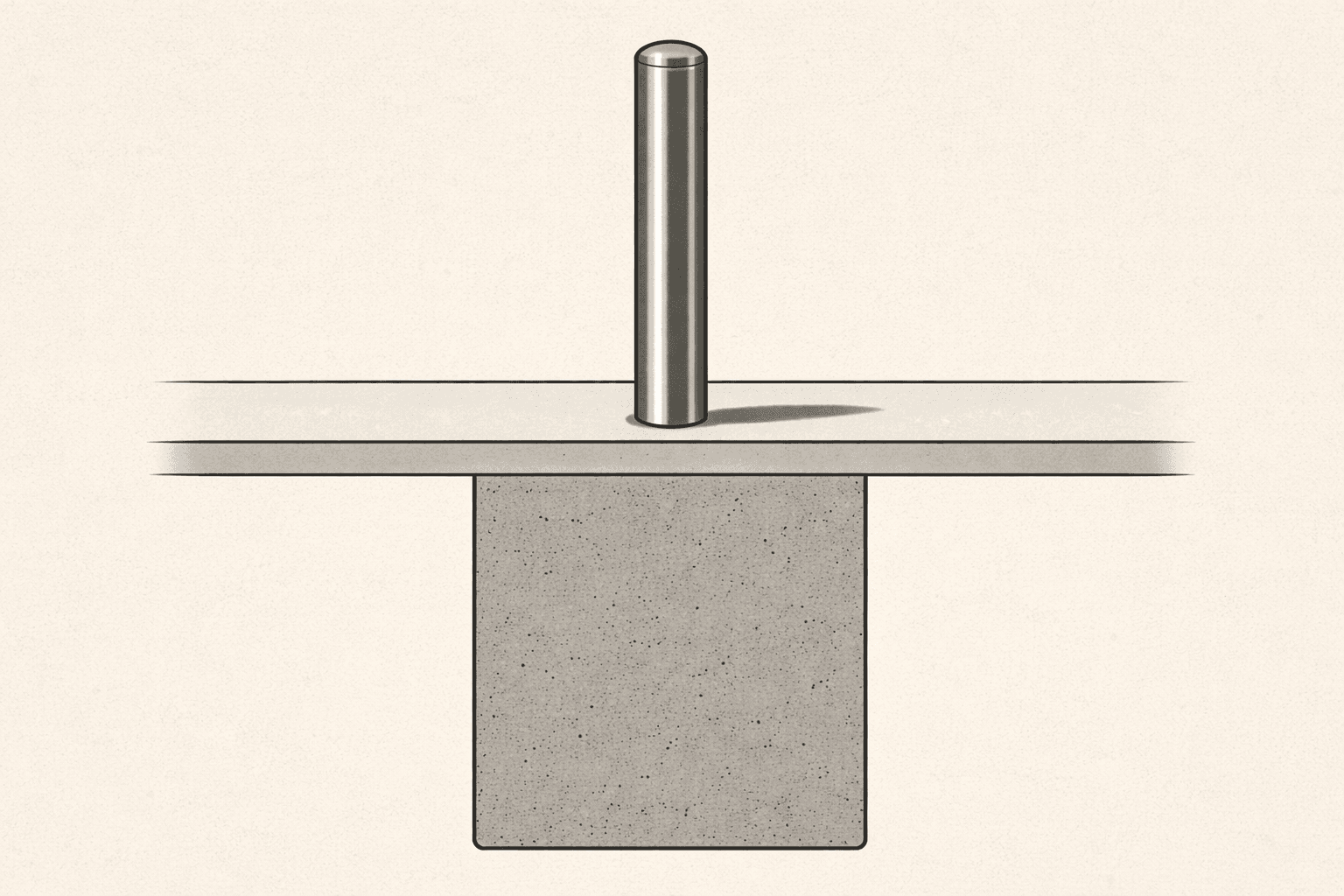
The secret to a bollard's incredible strength lies not in what you see, but in what you don't. On the surface, it's just a steel post. Below ground, however, a true security-rated bollard is like an iceberg. It's anchored into a massive deep foundation of concrete, often many feet deep and wide. This hidden structure is what actually absorbs the immense force of a moving vehicle, transferring the energy safely into the ground. The post you see is merely the tip of a powerful, deeply embedded defensive system.
This hidden depth is what separates a real security bollard from a simple decorative post. A decorative bollard might just be bolted to the sidewalk and would offer little resistance to a car. In contrast, crash-rated bollards are engineered and physically tested to meet demanding impact resistance standards. They are designed for one specific purpose: to stop a vehicle of a certain weight and speed dead in its tracks. This distinction is crucial, as only the tested system can be trusted to protect against a deliberate attack or a serious accident.
Ultimately, this engineered strength is why a line of these posts can reliably stop truck attacks and prevent out-of-control cars from reaching a building. They aren't just obstacles; they are carefully calculated systems of protection. By absorbing the impact far from the fragile glass walls, they neutralize the threat completely. This creates a buffer zone—an invisible shield that is the first and most important line of defense for a modern building.
How Bollards Create an 'Invisible Shield' Around Glass Walls
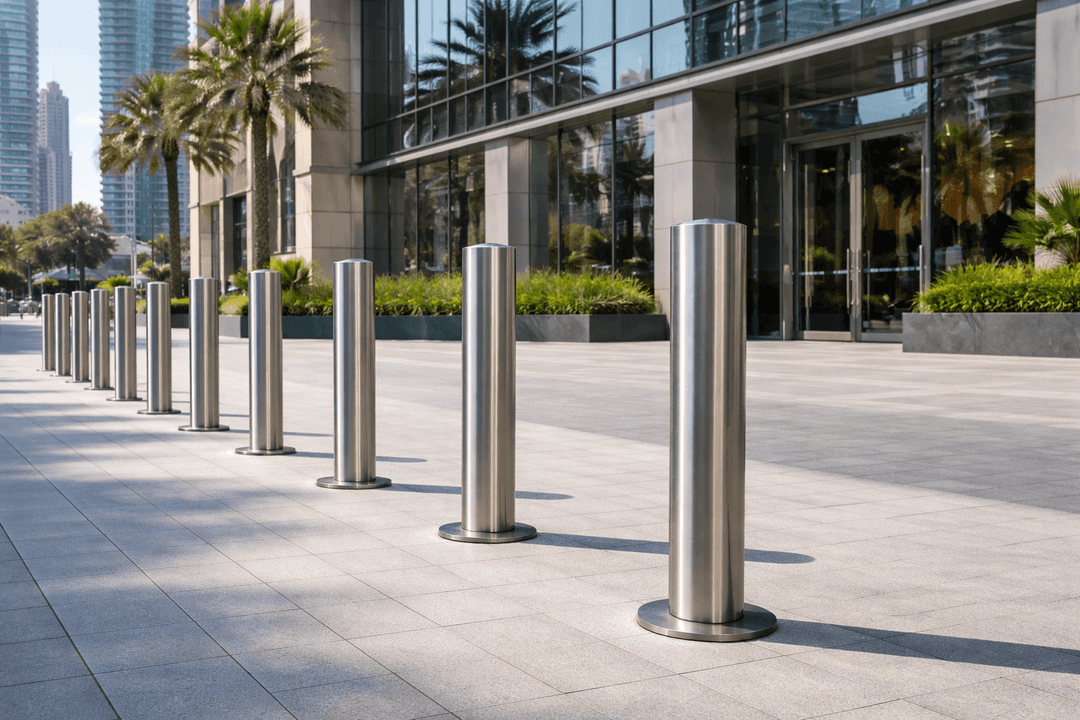
Knowing a bollard can stop a truck is impressive, but the real strategy lies in where it stops it. Bollards are almost never placed directly against a building. Instead, they are installed a calculated distance away from the glass front, creating what security experts call a standoff distance. Think of this as an invisible buffer zone or a modern-day moat. This space is the most critical element of the entire system, ensuring a threat is stopped long before it has any chance of reaching the fragile walls it's meant to protect.
This buffer zone is essential because the goal of perimeter security for glass facades is to prevent any contact whatsoever. Unlike a concrete wall that might just get a dent, a large glass panel can shatter completely from even a glancing blow. A vehicle making contact could send a dangerous spray of sharp fragments deep into a lobby or storefront. The standoff distance ensures that the impact happens at the outer line of defense, neutralizing the vehicle and its destructive energy safely away from people and property.
This careful bollard installation near glass windows is never an arbitrary choice. The exact distance provides enough room to halt a vehicle without its front end lurching forward to hit the glass, all while leaving clear, accessible pathways for pedestrians. But what happens when you need to provide access for an authorized vehicle, like a delivery truck or an ambulance? That's when simply having a permanent line of posts isn't enough.
Fixed, Removable, or Automatic: Which Bollard Is Right for the Job?
That question of allowing authorized vehicles through is exactly why not all bollards are created equal. While a permanent wall of steel is the simplest solution, modern spaces demand flexibility. Security designers must balance total protection with practical needs like emergency access, deliveries, and special events. This has led to a range of bollard types, each designed for a specific scenario.
At its core, the choice comes down to three main options, each serving a different purpose:
Fixed Bollards
These are the permanent sentinels, providing round-the-clock protection where vehicle access is never needed.
Removable Bollards
These offer protection most of the time but can be manually unlocked and lifted out to allow occasional vehicle access for events or maintenance.
Automatic Bollards
These are the high-tech guards that retract into the ground with the push of a button or scan of a card, allowing frequent but controlled entry.
You'll see fixed stainless steel bollards for modern architecture guarding the entire glass front of an airport terminal, where their job is simply to be an unbreakable line of defense. A removable post, however, might be used to block off a pedestrian plaza that opens to delivery trucks once a day. The greatest flexibility comes from automatic systems; the benefits of retractable security posts are clear at corporate entrances where employee vehicles can pass through while all other traffic is stopped. While there is a difference in fixed vs automatic bollards cost, the choice depends entirely on how a space is used.
Choosing the right type ensures a building is both safe and functional. But what about other heavy objects you see outside buildings, like those massive concrete planters filled with flowers? Are they just for decoration, or can a flower pot provide the same life-saving protection as a purpose-built security bollard?
Security Bollards vs. Concrete Planters: Is a Flower Pot Enough Protection?
It's a common assumption: a massive concrete planter or a decorative boulder must offer real protection. After all, it's heavy and solid. While these items look imposing, security experts see them as simple obstacles, not engineered stopping systems. An obstacle might slow or deflect a vehicle, but it can also be pushed aside, shatter, or be launched forward, continuing toward its target. This creates a dangerous and unpredictable situation, offering only a false sense of security against a determined or out-of-control vehicle.
The crucial difference in the debate of security bollards vs concrete planters lies hidden beneath the surface. A planter just sits on the sidewalk. When struck, its weight is the only thing resisting the force of a moving vehicle. In contrast, a security bollard is like an iceberg; its real strength is in a deep concrete foundation. This underground anchor allows the bollard to absorb and transfer a catastrophic amount of energy safely into the ground, stopping a vehicle cold rather than just getting in its way.
Ultimately, effective vehicle impact protection for office buildings comes from systems that are proven to work. Reputable security bollards are physically crash-tested to verify they can stop a specific size of vehicle at a given speed. When choosing the right bollard for building protection, this verified performance is what separates a decorative element from a true life-saving device. For facilities that must meet regulatory requirements, many projects rely on Security Industry Regulatory Agency compliant SIRA-approved bollards, ensuring both certified stopping power and peace of mind. This strength isn’t just for preventing accidents; it is also a critical defense against deliberate threats such as smash-and-grab raids.
How Bollards Prevent 'Smash-and-Grab' Raids on Glass Storefronts
Beyond accidental crashes, glass buildings face a more deliberate threat known as ram-raiding. In these "smash-and-grab" attacks, criminals use a vehicle as a battering ram to shatter a storefront, grabbing valuable goods in seconds. High-end retail stores with their inviting glass walls are prime targets, as their entire inventory is visibly on display, protected only by a fragile barrier that a car or truck can easily breach.
This is where security bollards become an invaluable deterrent. By creating an impassable barrier, they make the criminal's primary tool—their vehicle—completely useless. Learning how to protect glass storefronts from vehicles effectively starts with this simple, strong defense. For a potential thief, the sight of properly installed bollards is an immediate signal that their plan is destined to fail, often forcing them to abandon the attempt before it even begins.
Ultimately, the use of bollards for preventing ram-raiding in retail stores provides more than just property protection; it delivers peace of mind. This form of hostile vehicle mitigation for commercial buildings shields business owners from catastrophic damage and costly downtime, while the public can feel more secure in commercial spaces. These unassuming posts are a fundamental part of keeping our modern, open-plan buildings both beautiful and safe, giving you the first key to a new way of seeing your city's defenses.
Your New 'X-Ray Vision' for City Safety
Before today, the short, sturdy posts lining our city streets were likely just part of the background. They were objects to walk around, but not to truly see. Now, you can't unsee them. You have gained the ability to read a hidden language in our urban landscape—to recognize the difference between a simple decoration and a powerful protector.
Your next walk through a downtown plaza or past a modern office building can be an entirely new experience. As you move through your day, start noticing where these silent guardians stand watch. See if you can spot the "iceberg" of hidden strength—posts that you now know are deeply anchored to provide real protection. This simple act of observation transforms you from a passerby into an informed participant in urban safety.
You might wonder, "are security bollards a legal requirement?" While not a universal mandate, their presence almost always signals a thoughtful choice. It shows that architects and safety experts have assessed the unique risks to a glass building and have intentionally designed a solution, reinforcing the importance of security bollards as a specific, powerful tool for public protection.
The next time you enjoy the view from a glass-walled library or a bright, open lobby, you'll see more than just the architecture. You'll recognize the invisible shield standing guard just outside. These posts are the quiet commitment to safety that allows us to build and live in beautiful, transparent spaces with confidence and peace of mind.
Related reading: Steel Bollards Guide: Types, Crash Ratings and Spacing
Related solutions: Gate barrier systems · Physical security solutions
About the Author

Share this article
Connect With Us
Our Office Locations
Abu Dhabi
Head Office
Dubai
Branch Office
India
Branch Office - Calicut