
Smart Solutions, Safer Communities
LED vs LCD Video Wall: Which One for Your Control Room, Lobby or Boardroom?
Quick answer: For a control room where operators sit 2 to 4 m away and read small text and camera tiles all day, a narrow-bezel LCD video wall or a fine-pitch LED wall (about P1.2 to P1.5) both work; LCD usually costs less upfront but shows thin seams. For lobbies, atriums and large boardrooms, a seamless LED wall is usually the better choice because it is brighter and can be any size. The right choice depends on viewing distance, daylight, the wall structure and how many hours a day the wall runs, which is what a site survey checks.
Last reviewed: November 2026, by the Transit AV and ELV team.
How LED and LCD video walls differ
Both types build one large picture from smaller units. An LCD video wall tiles flat panels with very thin borders. An LED video wall joins cabinets of LED modules, where every pixel is its own light source.
LCD video wall
- Built from narrow-bezel LCD panels, commonly 46 or 55 inches, in grids such as 2x2, 3x3 or 4x3.
- Very sharp text and detail up close, because each panel is full HD or higher.
- Thin seams between panels remain visible.
- Bright enough for most indoor rooms without direct sunlight.
- The wall size grows in whole-panel steps.
- Usually the lower upfront cost for small and medium walls, and a failed panel is simply swapped.
LED video wall
- Built from LED cabinets that join with no seams, in any size or aspect ratio, including very wide or curved walls.
- Brighter, with a wide viewing angle, and it can be dimmed for darker rooms.
- Sharpness depends on the pixel pitch: the smaller the pitch, the closer people can sit.
- More heat and power per square metre, so cooling, power and the wall structure need planning.
- Front-serviceable cabinets can be repaired module by module from the front.
Pixel pitch and viewing distance
Pixel pitch is the distance between the centres of two LED pixels, in millimetres. P1.5 means 1.5 mm. A smaller pitch packs more pixels into the same area, so the image stays smooth when people stand closer.
A simple rule of thumb: the closest comfortable viewing distance in metres is about the pitch in millimetres, and most people are comfortable from 2 to 3 times that distance.
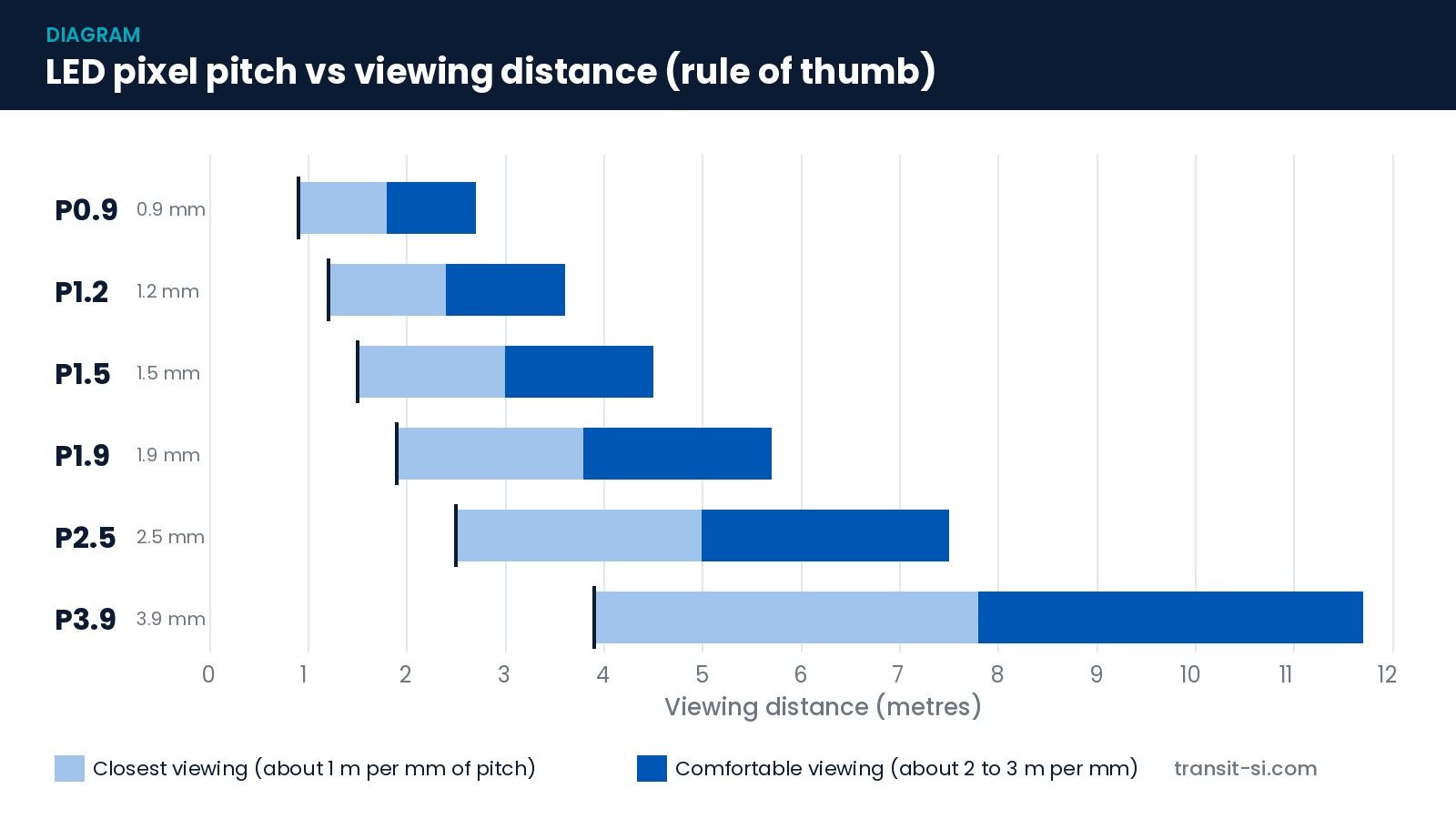
- P0.9 to P1.2: boardrooms and control rooms where people sit 1 to 3 m away.
- P1.5 to P1.9: control rooms and meeting rooms, viewed from about 2 to 5 m.
- P2.5: lobbies, reception areas and auditoriums, viewed from about 3 to 7 m.
- P3.9 and above: large halls and outdoor screens, viewed from about 5 m and more.
Choosing a finer pitch than the room needs adds cost without a visible benefit. Choosing one that is too coarse makes text and faces look grainy for the front row. LCD walls don't have a pitch choice in the same way; their sharpness comes from the panel resolution.
Brightness, heat and UAE conditions
- Daylight: lobbies and atriums with glass walls get strong sunlight for much of the day. Standard displays look washed out, so these spaces usually need a high-brightness LED wall. Control rooms are the opposite: the wall should be dimmed to an even, comfortable level for long shifts.
- Heat: video walls often run 12 to 24 hours a day. Every display adds heat, and LED walls add more per square metre, so the room's air conditioning must handle the extra load and the wall needs ventilation space behind it.
- Dust: dust builds up on fans and filters faster in the UAE. Plan for regular cleaning, and for outdoor screens choose a suitable IP rating (see our outdoor LED screens).
- Power: use dedicated circuits, surge protection and, for control rooms, UPS backup so the wall and its controller stay on during short outages.
Control room vs lobby vs boardroom
Control rooms and operations centres: Operators look at the wall all shift, so even brightness and colour matter more than peak brightness. Choose panels rated for 24/7 use, a controller that shows many camera feeds and dashboards at once, and KVM-over-IP so operators can share sources from their desks. Narrow-bezel LCD and fine-pitch LED both work here.
Lobbies, reception areas and retail: The wall's job is to make an impression and be readable in daylight. A seamless LED wall is usually the better fit, with content scheduled from a digital signage system.
Boardrooms and meeting rooms: People sit close and read slides and spreadsheets, so pick fine-pitch LED (about P0.9 to P1.5) or a narrow-bezel LCD wall, connected to the room's AV and conferencing system for presentations and video calls.
What a site survey checks
Before we recommend LED or LCD, we visit the site and check:
- Wall load and structure: the weight of the panels or LED cabinets and the mounting frame, and whether the wall needs a steel sub-frame.
- Power: dedicated circuits, socket positions and UPS backup where needed.
- Heat and ventilation: the extra heat load on the air conditioning and the space behind the wall.
- Controller and sources: how many cameras, PCs, dashboards and media players feed the wall, and the cable routes back to the rack.
- Viewing distance and daylight: where people sit or stand, and how the light changes during the day.
- Service access: whether the wall can be serviced from the front or needs rear access.
Controllers and sources
A video wall is only as useful as what feeds it. A video wall controller (or processor) takes inputs such as CCTV camera streams, PCs, dashboards and media players, and arranges them across the screens. Layouts can be saved and recalled, for example a normal-day view and an incident view. In control rooms, KVM-over-IP lets each operator pull a source onto the wall or take control of a PC from their desk. For CCTV, the wall usually shows camera tiles from the video management software, so plan the CCTV system and the wall together.
Maintenance
- Calibration: check brightness and colour across the wall periodically so panels or cabinets still match.
- Spares: for LED walls, keep spare modules from the same production batch so replacements match in colour.
- Cleaning: clean screens with the manufacturer's recommended method, and clean fans and filters regularly in dusty conditions.
- Controller and software: keep firmware and controller software up to date and back up the saved layouts.
- Support: warranty follows the manufacturer's terms; an annual maintenance contract covers regular checks and quick response.
Our video wall projects
- AV, SOC and ELV solutions at Mubadala Tower, Abu Dhabi: an LED video wall with IP/KVM control for the security control room.
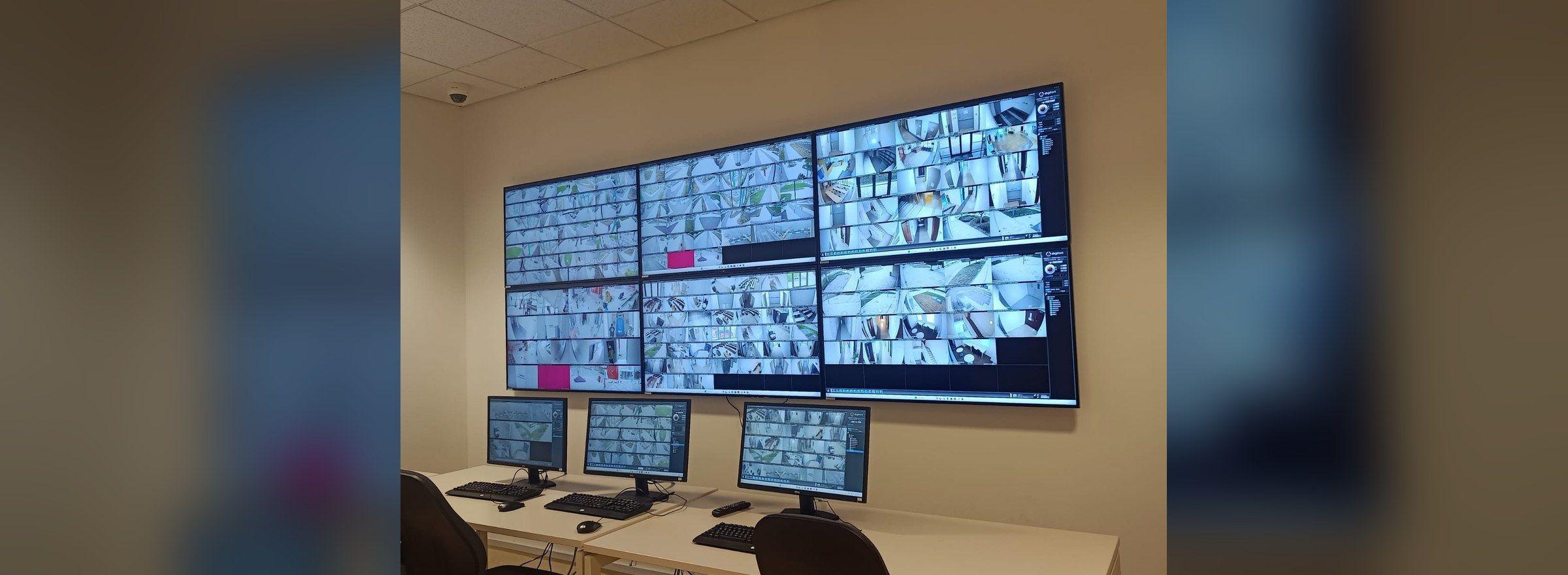
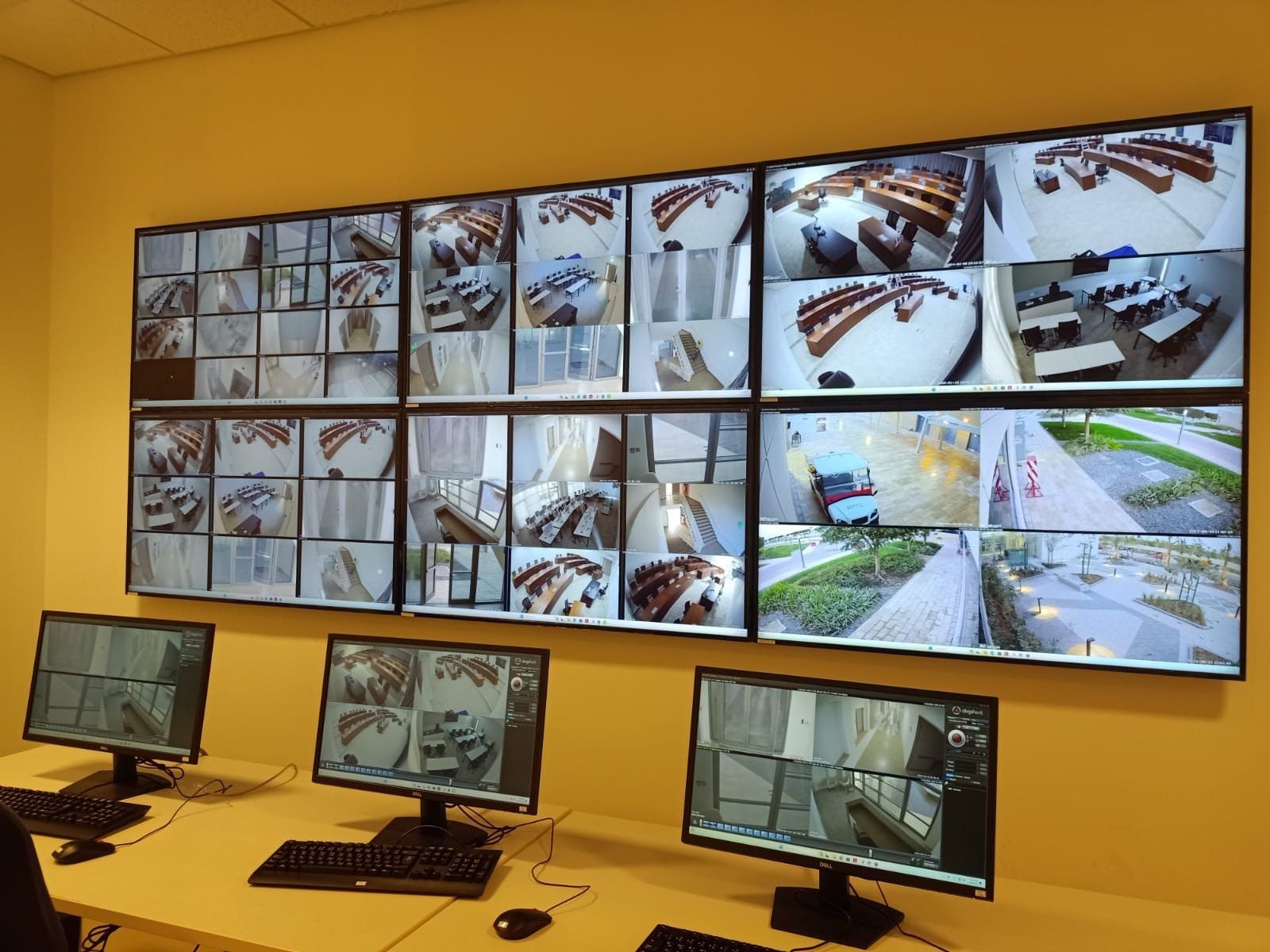
- A security control room in Abu Dhabi with a six-screen video wall, three operator workstations, CCTV and access control (photos above).
- Digital signage for a restaurant group in Dubai: commercial displays with scheduled content.
See our video wall installation service for brands, options and areas we cover.
Frequently asked questions
Is LED or LCD better for a control room? Both work. A narrow-bezel LCD wall gives very sharp text at 2 to 4 m and usually costs less upfront, but shows thin seams. A fine-pitch LED wall (about P1.2 to P1.5) is seamless and can be any size, but needs more planning for heat and power.
What pixel pitch do I need for an LED video wall? As a rule of thumb, the closest comfortable viewing distance in metres is about the pitch in millimetres, and most viewers are comfortable from 2 to 3 times that. Boardrooms and control rooms usually need P0.9 to P1.9, lobbies P1.9 to P2.5, and large halls or outdoor screens P3.9 and above.
Can a video wall work in a sunny lobby with glass walls? Yes, if it is bright enough. Lobbies with daylight usually need a high-brightness LED wall, with cooling planned for the extra heat. We check the light at different times of day during the site survey.
Can a video wall run 24/7? Yes, if the panels are rated for 24/7 use and the room is cooled and powered for it. Control rooms should also use UPS backup and plan regular calibration and cleaning.
Do you install video walls across the UAE? Yes. From our head office in Abu Dhabi and branches in Dubai, Ras Al Khaimah and Fujairah, we survey, install and support video walls in all seven emirates.
Talk to Transit
Transit Security Solutions designs, installs and supports LED and LCD video walls for control rooms, lobbies and boardrooms across the UAE. Tell us about the room, the viewing distance and what the wall needs to show, and we will recommend the right option after a site survey. Email sales@transit-si.com, call 02 553 8502, or contact us.
Related services: Video wall installation · Indoor LED displays · Digital signage · AV and meeting room systems
About the Author

Share this article
Connect With Us
Our Office Locations
Abu Dhabi
Head Office
Dubai
Branch Office
India
Branch Office - Calicut